The case for a social heart and a social design framework
Abstract
This article makes the case for social as a core game pillar as a means of creating robust and scalable games in today’s challenging market. At the heart of this strategy are games’ unique ability to provide both escapism and community during times of uncertainty and stress. It also provides a design framework to help developers start exploring the world of social games.
The article is organised into the following chapters:
- Introduction
- Social’s value to the players and the product
- The mindset to open pandora’s box
- Six design pillars
- Social Profiles
- Empathy Hierarchy
- Social Agency
- Social Opportunity
- Safety Through Moderation, Education and Codes
- Virtuous and Vicious Cycles
- Conclusion
Introduction
Creating successful games on mobile is a challenge that only seems to get worse with time. Every generation of developers has said something along those lines, but today we are facing two particular difficulties that have a profound impact on our ability to succeed: width of competition and depth of competition.
We are bombarded by information that constantly pulls our attention in every which way. It’s within that chaotic space that games jostle with everything for the patronage of users – with TV, with music, with YouTube, TikTok, and every social media platform. This competition is not only with what is available on mobile devices, it is also with books, movies, education, with every hobby and interest under the sun. This is the width of competition. A new user for our game means ripping them away from something else, and there is just so much else out there. We resort to all sorts of tricks (and obfuscations, manipulations and lies too) to get players into our ecosystems, and then we use all sorts of tricks to stop them from being ripped away from us.
But even if we limit our definition of competition to just the games market, said market has become an absolute morass of noise and conflicting signals that make organic discovery near-impossible. This is the depth of competition: the staggering number of games and apps published on a daily basis that we must contend with, in addition to the established giants that rule the distribution and promotion channels.
How can we overcome this width and depth problem? The solution that I want to propose can be found in some of the darkness that clouds our modern age. As a society we are growing increasingly lonely, isolated and polarized, with technology and economics exacerbating the uncertainties, anxieties, stresses and fears that loom over most of us in one form or another and seeps into our habits.
I posit that video games are unmatched in their ability to soothe these feelings by offering both escapism and community; and to do so with both a level of ease and intensity that is unrivalled. And I also posit that the strongest way to capitalise on these qualities is by embracing socialness and making it a core pillar of the games we create.
It’s not a miracle solution to the problems of width and depth of competition, but I believe that the bonds and connections forged in social games can create the most enduring and resilient of products.
Social’s value to the players and the product
There’s plenty of articles touting the benefits of social systems; they are repeated to the point of taking almost dubious qualities. I do believe, backed by my own experiences, that social features can have a profound impact on a game’s metrics. But they are not a cure for bad gameplay or bad systems, and they can absolutely turn out to be a waste of resources if executed poorly.
But before speaking of metrics, I believe it is more important to start by looking at what are the qualities of a social experience and their impact on players, and only then tackling how these qualities translate over to product metrics. Let’s break this down into player and product.
Let’s start with the player-facing qualities:
- Onboarding
- Bonding
- Sharing
- Leadership
- Resilience
- Social Buzz
Onboarding – A player’s opportunity to learn through their peers.
Communities look after their own. This is especially important within multiplayer games, where one’s performance tends to impact other players. For many players, the idea of performing badly and of being judged by their peers can cause stage fright, or even outright paralysis. When a community is reachable directly within the game, players have the opportunity to learn from their peers, rather than to be intimidated by silence or passive-aggressive displays.
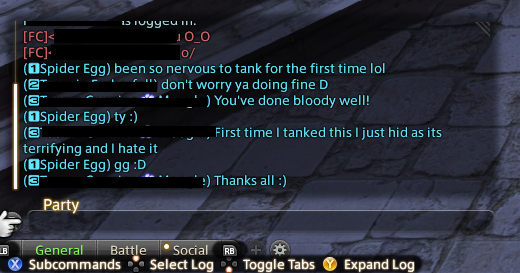 Final Fantasy 14: Players encouraging a novice tank and reassuring them that everything will be fine.
Onboarding is also not limited to being new to a game – onboarding happens every time a player experiences something new, such as a new feature, a new system, or a new piece of content. Tapping into a community’s will to teach is a powerful asset.
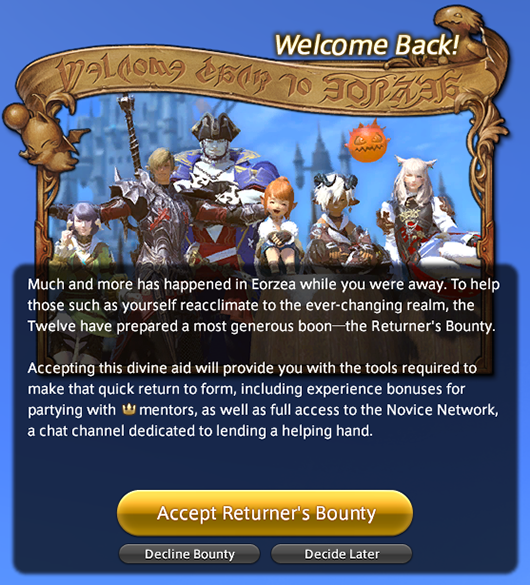 Final Fantasy 14: Veteran players returning to the game after long pauses are encouraged to join a social support network.
Bonding – A player’s ability to form lasting relationships.
I briefly touched on the idea earlier that games are uniquely positioned as platforms to help us connect and develop bonds. The difficulties of making new friends, especially as we grow older, are fairly well detailed (and thoroughly commoditized). It’s no surprise that the workplace becomes a springboard for friendship, as it provides a shared interest that acts as both an icebreaker and an ever-refreshing source of topics. Forming friendships begins with bonding, and while games are not unique in providing shared interests to bond over, they stand out in how they combine fun, low effort requirements, and vast availablility on demand.
To start with it’s worth pointing out that every game – online or offline, single player or multiplayer – is a vector for bonding. If you are a Dwarf Fortress fan, you’ll find communities all over the web that you can join and instantly feel like you’re amongst peers, and from there you can begin to learn about the individuals of that community and close the gap with some of them.
Where online multiplayer and social games shine brightest is in providing more immediate, intimate and relatable shared interests. A shared interest in overcoming this dungeon. A shared interest in building this town. A shared interest in defeating that other group of players. These help bring players together towards a common cause, breaking the ice in the process. These shared interests also allow players to partly reveal who they are: their communication and play styles, their preferences and their skills. This is valuable information that can be used to decide who is worth pursuing a closer bond with.
All of this is achieved without the many challenges that we would normally be facing in the world, such as geographical location and economics.
Reciprocity (and peer pressure) – A player’s willingness to act in kind.
Receiving makes us want to give something back, be it as an immediate response or as a longer term social contract. Given that the means to reciprocate exist in our environment, reciprocity can greatly shape our behaviours. As a developer this is a powerful asset to help us create virtuous cycles in our communities: the more benevolent players exist, the more they can imprint their benevolence on others.
But reciprocity can also mean retribution, when rather than receiving a kind act we receive a hostile one. This is a potential danger that can be hard to perceive as developers since we are so deeply enmeshed with our projects; we are essentially insulated from seeing things from the perspective of a human with no stake in the game other than a pursuit of having a good time. That said, retribution is not an inherently bad thing. Given a just cause, retribution can be both a warning and a tool for education.
- Thanking a player for reviving your character is a very common form of reciprocation. For aid rendered -> a social ackowledgement is given.
- Kicking a player out from a party due to their behaviour is just retribution. For poor behaviour -> your presence is not tolerated.
That said, reciprocity can also be weaponized through peer pressure. This particular quality is what most players are familiar with in games that tack on social features as a means to an end. By making players receive help from others, or by making them work together towards a goal, a burden of participation is placed on them all. This takes on a darker tone when a player feels disengaged from a game or activity, yet also feels forced to participate for the sake of others or for fear of being excluded.
The 4X strategy genre (eXplore, eXpand, eXploit, eXterminate) on mobile is incredibly notorious for weaponizing peer pressure to get players to open their wallets on a regular basis, in fear of feeling the wrath of their guild.
Sharing – A player’s desire to open up their experience to others.
We are social creatures and typically find pleasure in sharing our experiences: a movie, a book, a trip, even advice. Games are no exception in this regard, and better yet provide a tremendous number of opportunities for sharing. In single player games this often takes the shape of “let’s plays”, live streaming, reviews, guides, deconstructions, and so on.
Social game experiences take sharing a step further by providing engaging scenarios to not only watch together, but work through together and get excited and sad about together. There is a feeling of presence, camaraderie and unity that only exists within those gameplay moments.
Leadership – A player’s opportunity to meaningfully lead other players.
Leadership is a concept that we are often drawn through one way or another in many facets of our lives. In our careers, with our friends, in our hobbies and of course in the games we play. A myriad of reasons are possible for this: power, recognition, status, money, or altruism amongst others.
Games provide plentiful opportunities for leadership, from reviewing games or being a content creator, but social games once more rule the roost by providing meaningful leadership opportunities within the games themselves. Running a guild, being the captain in a group of friends or eSports team, acting as a mentor to newer players, and so on. Being able to fulfill ambitions of leadership is a highly compelling draw to many players, when these opportunities can be rare in the world.
The recurring theme across all of these qualities is that the element of togetherness only present in multiplayer games means that we can bring over a greater spectrum of social interactions from the real world directly into the game. In doing so, we are better able to differenciate ourselves from each other and we feel more like unique individuals. This helps us get more insight into other players, and find commonality; key ingredients for forging bonds.
The more a game enables these qualities above, the more it is able to achieve two powerful additional qualities: resilience and buzz.
Resilience – A player’s ability to endure negative feelings and experiences.
Resilience is most often discussed in regards to monetizing Free to Play games: “how painful can I make this situation, so that the player will be frustrated enough to consider paying, but not enough that they outright quit?”
Social resilience is similar, though coming from a more benevolent angle: “how can we make a player feel safe enough so that, on encountering a painful social situation, they view it as an anomaly in their game experience that they can move on from?”
That sense of safety is what onboarding, bonding, reciprocity, sharing and leadership enable. Having a community to catch us when we fall, friends to turn to for support, kind strangers to stand up for us, even a leader to help us achieve retribution. And social issues will flare up eventually, no game is an exception to that. The more chances players are given at developing this resilience, the better for when a problem finally happens.
Social Buzz – A player’s desire to be present in a game for its social qualities.
The social buzz is the culmination of all of these qualities into a true social experience, one that player hold as equally important as gameplay, and potentially greater. This is not something that every game can achieve, and definitely not something that every game should aspire to achieve simply because of the monumental amount of work required. But games that do can transcend their status as a game and become something more.
Fortnite, Roblox, MMOs like World of Warcraft and Final Fantasy 14, experiences like VRChat, are all such examples where the community is a unique selling point. You are not simply playing a game, you are joining a community that has developed a culture.
Now let’s look at the product-facing qualities.
Once we understand the player-facing qualities, it becomes rather obvious how they translate into product-facing ones, and why social is perceived as a a bit of a miracle pill.
We can focus on the four product metrics that are most affected: acquisition, engagement, retention, reacquisiton, which result in product resilience.
- Acquisition – your ability to bring in fresh new players into the game. A social experience is a shareable experience, especially in a multiplayer setting. It’s an opportunity to help others discover something new and experience the same emotions you have, and happy communities and content creators will facilitate acquisition. Social experiences are also more chaotic and unpredictable, which gives them an extremely powerful viral potential.
- Engagement – your ability to get players to spend more or better quality time in the game. Social ties, appointments and obligations.
- Retention – your ability to bring a player back to the game day after day. Some of the most powerful calls to action come from social settings. Friends want to play, the guild wants to raid, you promised to play with a friend. Even when a player beguns to churn from lack of interest in the gameplay, social connections can continue to keep them in your ecosystem.
- Reacquisition – your ability to bring back players who have abandoned the game. Enduring social ties. Sticking with your friends. Remaining in the game community outside of the game.
This all builds into product resilience; a product’s ability to weather a bad storm and come out on the other side with players still willing to give it a chance.
It’s worth stressing that these benefits rarely make themselves apparent right away. Players first need to feel engaged by a game before social systems show any value, meaning that social systems are not a magic bullet to a poor product.
The mindset to open pandora’s box
Not everyone vibes with social features, let alone social games. This is a significant challenge if you, your team, or your stakeholders don’t. We are always looking to create fun and engaging experiences, but as developers we need to at least relate to a degree with the subject matter. Social needs to be championed by excited developers, otherwise they will typically make their way to the bottom of feature backlogs.
Social is also a fairly granular concept. On one hand we can talk of social as a full aspiration, and on the other as only a means to an end. Being honest about this is important because priorities and scope will shift heavily depending on the goal. There’s also no shame in pursuing social in a limited fashion to drive game metrics.
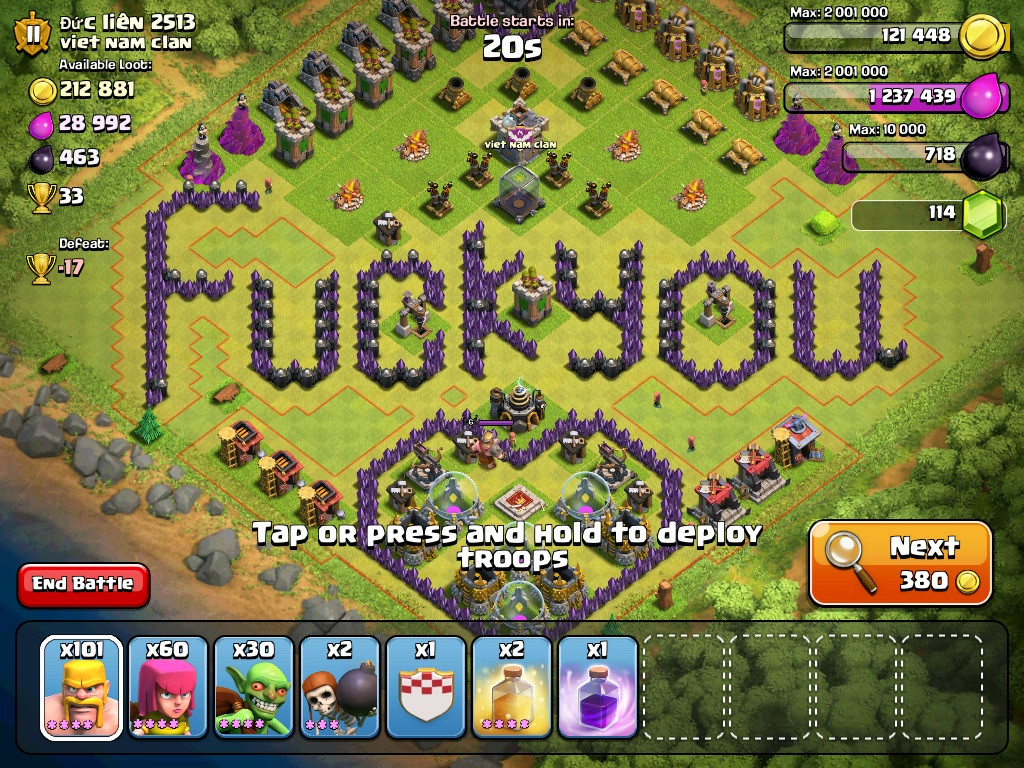
Finally, to include social features, let alone to build a social game, requires letting go of our absolute control over the game experience. You can craft the most meticulous, engrossing and immersive first time experiences for your game, but you cannot guarantee that a player won’t get told “get fuck yourself” as their first message in a public chat, or that they won’t be matched together with trolls and get repeatedly mistreated. The more you wish to open Pandora’s box, the more you must be willing to roll with the punches and think carefully about when and how to impose control over the chaotic nature of human players… and how much it will cost.
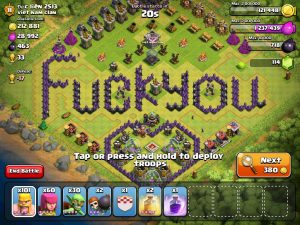
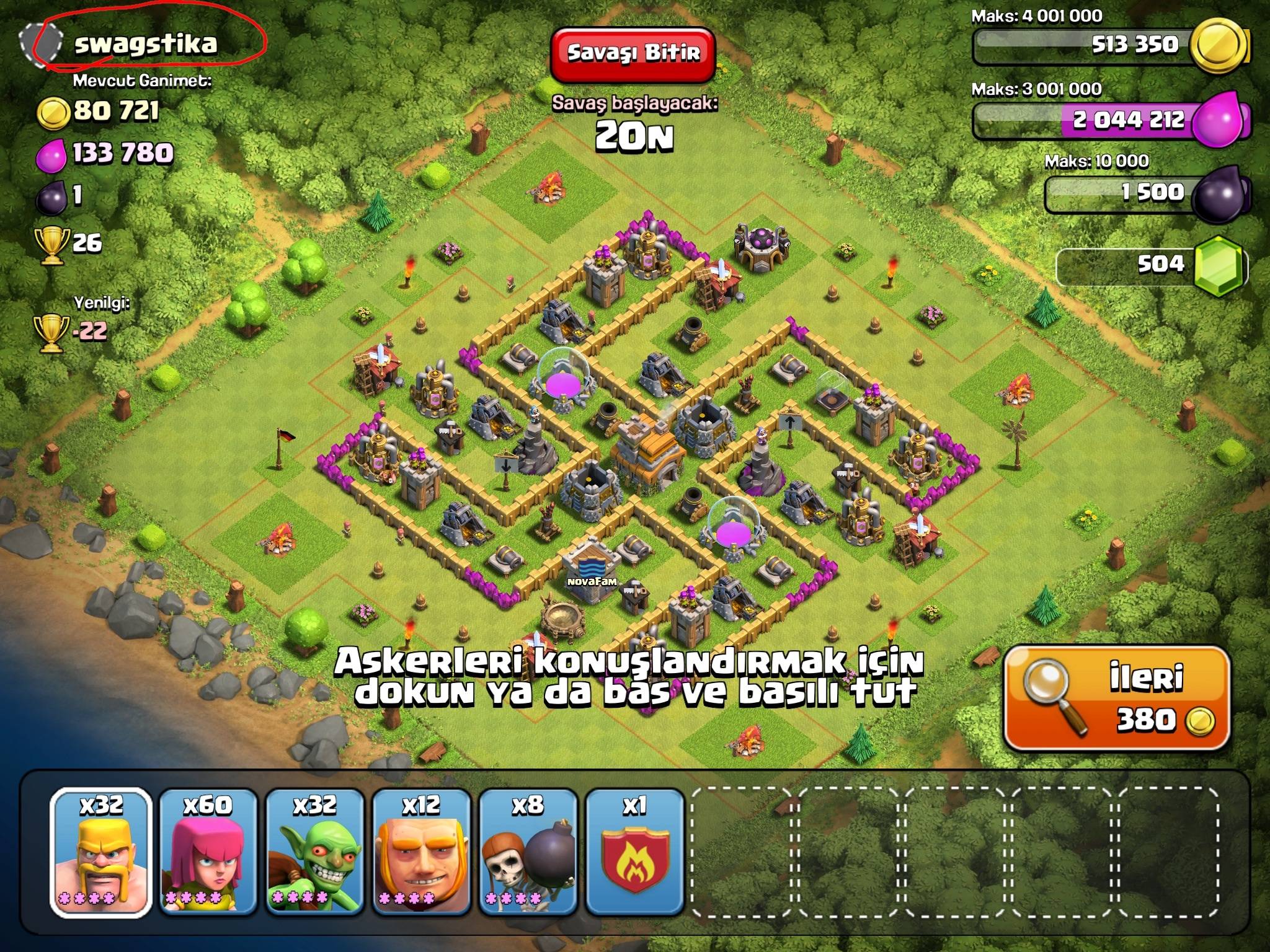
 Clash of Clans: User Generated Content can be extremely difficult to moderate and players can get very creative in finding workarounds.
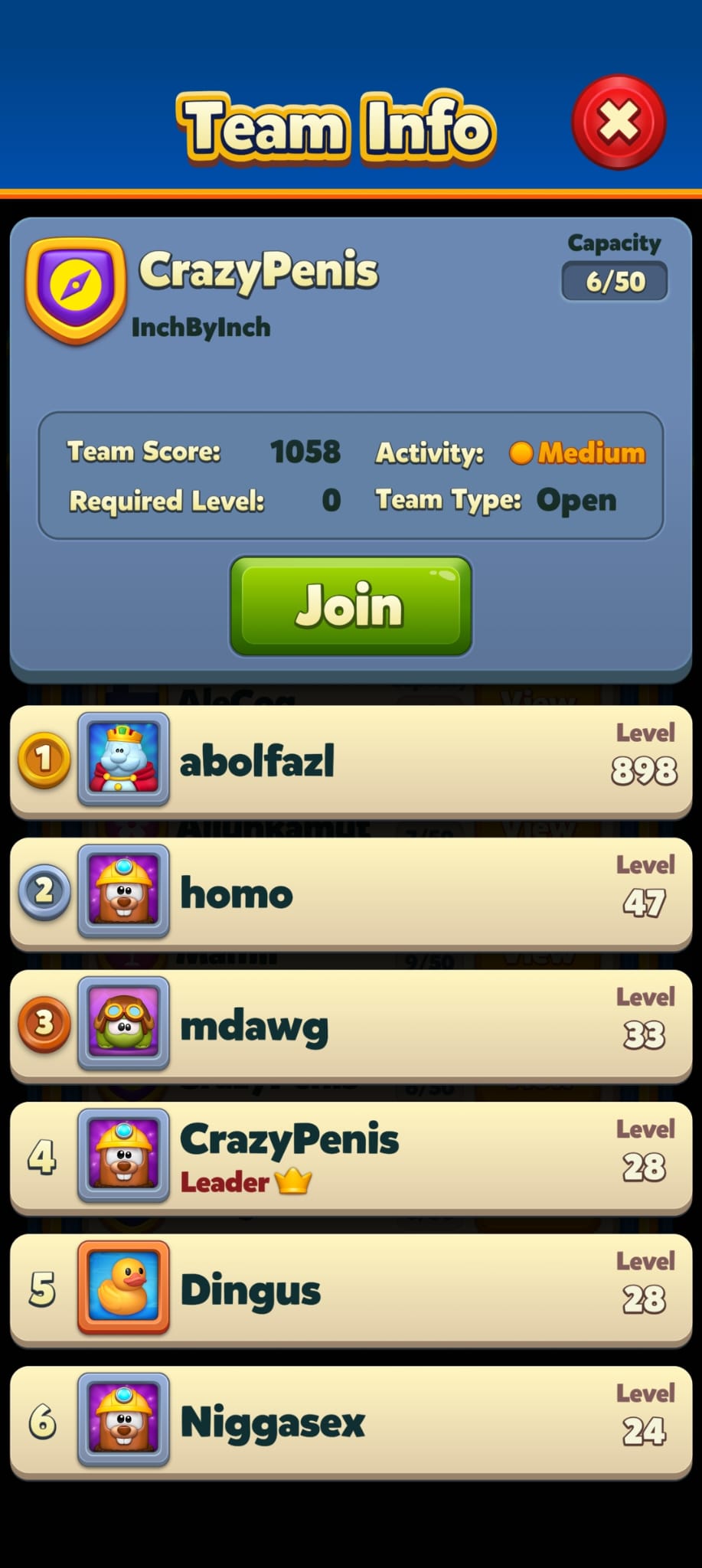
 Royal Match: The game has an extremely limited filtering system for words, enabling players to be as destructive as they wish.
Six design pillars
Let’s get to the meat and potatoes. In order to drive good design in social experiences, I refer to six design pillars to make sure that not only am I making good decisions in my work, but also that I am conscious of the potential long tail ramifications of these decisions.
- Social Profiles
- Empathy Hierarchy
- Social Agency
- Social Opportunity
- Safety and Education
- Virtuous and Vicious Cycles
Social Profiles
The ways that we socialize in our day to day activities are as diverse as it gets: each of us has a unique and complex way of doing so, from when to who, how and why. The same applies to games, and players are neither monolithic entities nor should be assigned to neat little boxes in terms of behaviours. As developers we tend to forget this or can find it very difficult to see, socially, from different perspectives.
The social profiles are a tool to help do exactly that: think from different perspectives, and be aware of how the systems we build will affect players. Rather than boxes, they represent three different mindsets, or profiles, that a player can fluidly shift between depending on the circumstances.
- Organisers, who love to be at the forefront and rally and inspire other players.
- Members, who pursue the simple goal of enjoying themselves in the game.
- Observers, who are quiet and reserved but still want to be part of a social world.
Organisers will take on a wide variety of shapes: guild leaders, friend group coordinators, raid team organizers, content creators and guide writers, amongst many more. These players are motivated by the opportunity to show leadership, influence others positively, and be recognised as such. They are players who find teamplay and cooperation to be great sources of pleasure. They’ll gladly expend energy and time towards these goals, often more outside of the game than inside.
Catering to organizers means creating opportunities for leadership and coordination, and venues for visibility so that they are able to find and be found by members and observers. Their nature often means that they are naturally resilient (or develop resilience) to social stress, as having to wrangle players or engage with an audience can be highly demanding and exhausting.
It’s important to note that organisers can exist in very specific and narrow circumstances. For example, being the activity coordinator for a group of friends. Outside of those circumstances an organiser might retreat into being a member or even an observer.
Members are, in most cases, who comes to mind if you were to think about a typical player. They are here to experience the game and have a good time doing so.
Catering to members principally means keeping an eye out for UI and UX friction. The goal of having a good time often means doing away with impediments and annoyances, so any kind of feature or system that causes too much friction is at risk of failing to be adopted by members. On the flip side, any feature that is adopted by members is likely widely to be further adopted by most players, simply because members have made its useage the norm. Think: non-verbal communication or party finder tools.
Observers are our last profile, but far from the least. These players want to be invested in a vibrant, living world, but also want to keep their distance from social interactions and expectations for any number of reasons. Some of those reasons can be fairly straightforward: generally being shy around other players, while others can be much more painful: retreating from social activities due to abuse, harassment or discrimination. Fear of abuse or of causing disappointment can likewise keep a player locked as an observer.
Catering to observers can be challenging because we need to not take these players for granted. Quality of life and safety features are high on the priority list for observers:
- Being able to turn off their online display and other privacy options.
- Robust reporting and moderation systems.
- Non-verbal communication tools.
- Clear game UX to convey information.
- Good onboarding, tutorialization or opportunities to develop social confidence.
The other side to catering to observers is about providing options and alternatives to systems or content that would otherwise force socialization.
- Forced social scenarios in order to experience a game’s story.
- Forced social scenarios in order to experience or progress through a game’s end game content.
Due to their more quiet nature it can be easy to forget that observers exist. Given a strong enough negative experience, even the most social of player may suddenly become an observer.
A fairly easy way to incorporate these social profiles into a design workflow is by asking a few questions:
- How is this piece of content going to be interpreted by each profile?
- How mandatory is socialness to engaging with this content?
- If there are no alternatives to being social, how can I help players build confidence in themselves before engaging with this content?
- Can this content be weaponized by players against other players?
- Can I create moments within that content that can help a player move upwards in social confidence? From observer to member, member to organiser?
Social Profiles can also play an important role in creating more complete and realistic player personas.
Empathy Hierarchy
When a player enters a social game world, or experiences a social feature for the first time, they’ll be wondering what is their place within said world. It’s no different from joining a new employer or a new group of friends: who are these people, how should I behave with them? What do they expect of me, how will their lives change with my presence?
The Empathy Hierarchy is a way of processing how a player feels about themselves and the social world they stand in, and in turn how they interact with others. We can think of it as a 3-layered pyramid:
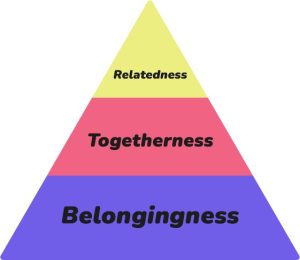
- Belongingness: I have a place in this world; I am confident I can express myself.
- Togetherness: I feel chemistry with other players; together we can achieve great things.
- Relatedness: I can change my behaviour for the sake of others; I understand my actions have consequences.
Players progress through these building blocks one at a time, with each building block requiring more engagement and effort to achieve.
Belongingness is the the first and most important building block, without which the others cannot exist. Without belongingness, a player may not even bother returning to the game. Why would they, if they don’t belong?
Belongingness can be split into three facets:
- Finding like-minded players
- Feeling safe and trusting of security
- Being able to progress towards goals
Finding like-minded players essentially means finding players who we fit in with, whether this is at the level of the game’s community or through a group of friends. Players who they can talk to and engage with that have values consistent with theirs.
- A game like League of Legends attracts a highly competitive global community that is notorious for easily and quickly lashing out. For many, they will never feel like they can belong in such a game, except perhaps by insulating themselves off with a group of friends.
- Whereas a game like Sky, which attracts players seeking cozy and social mechanics, has a very laid back and chill global community. For many, this is not ‘game like’ enough and they’ll never feel like they belong. They’ll always have this anxious feeling of wanting something more intense than what Sky and its community can offer.
Feeling safe is a fairly complex facet that mixes community and moderation. In a social game, it’s only a matter of time until a player suffers some form of abuse, harassment, or other negative experience at the hands of other players. Depending on how the global community perceives the abuse, a player may feel more or less safe.
For example, in competitive team-based games it’s common for a player who lost a match to send a stream of abuse to who they perceived was the weakest link of the team. The community will often consider this to be a minor event and part of the game experience. If the victim disagrees with this stance, they increasingly feel othered from their peers.
Safety is also highly shaped by how seriously a developer is willing to take action. Games that lack reporting features, or where reports never result in actions, don’t inspire a sense of safety. For any player who already feels othered, this can be the end of the road.
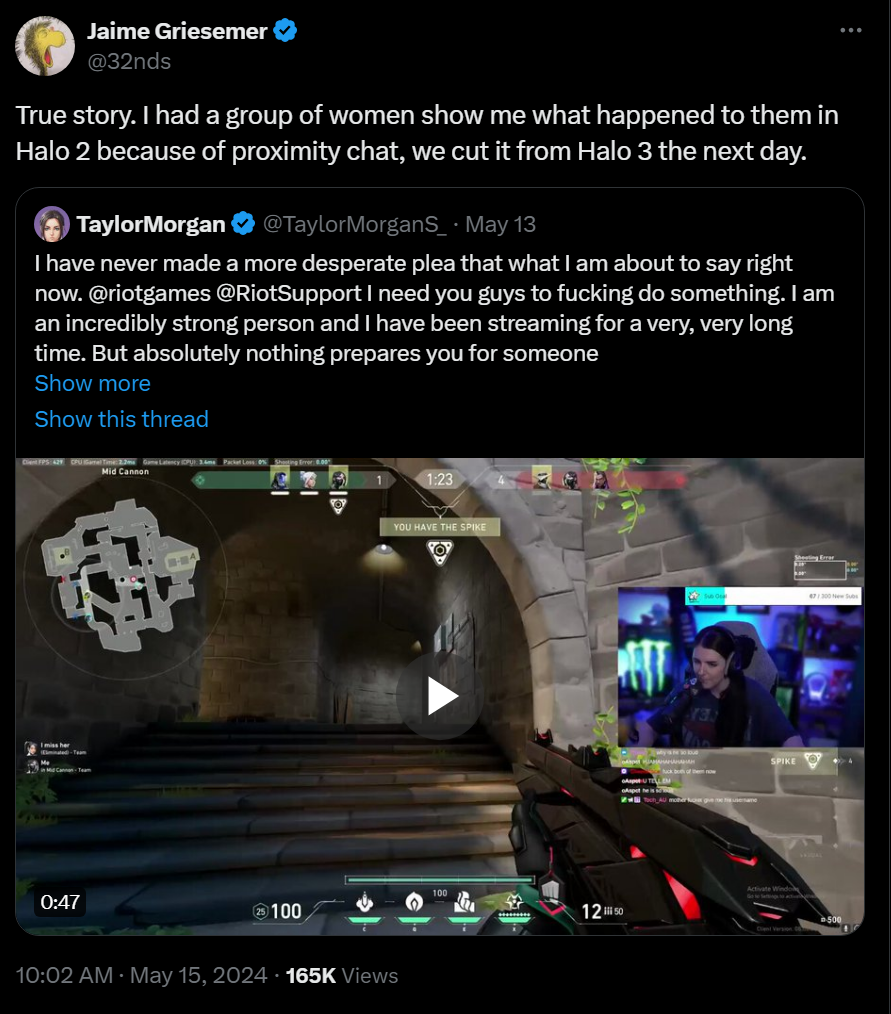 A typical and sad reality for women on voice chat is to be the target of abuse, and for the game community to think little of it.
Ultimately, for a player to feel like they belong, they must be able to make progress towards game goals. This might sound obvious, but if progress can only be achieved by creating a multiplayer party, a socially anxious player might consider that progress is impossible.
Togetherness is our second building block: now that a player has a sense of belonging, they are able to see that by working together with other players they can achieve great things. In multiplayer cooperative games this is fairly obvious: in a competition a well-oiled team will outperform a disparate one. A solid group of players will overcome raid challenges that stumps lesser groups.
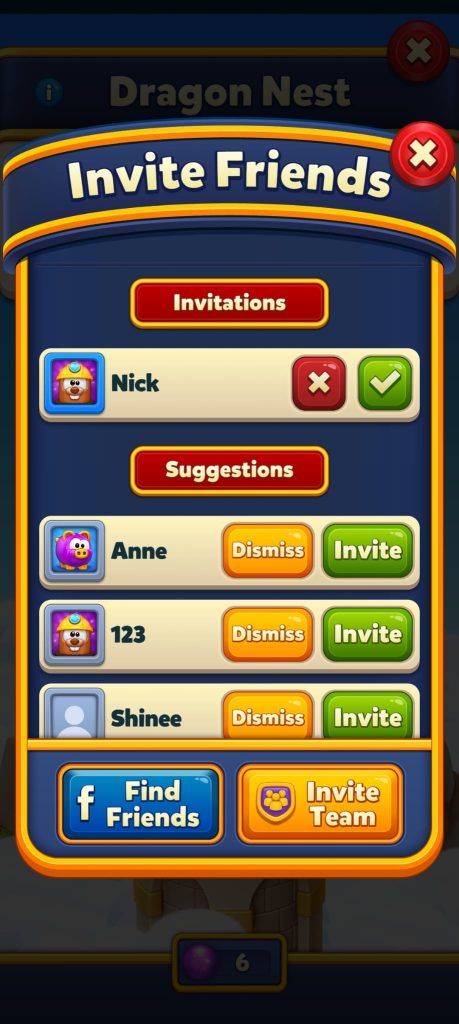
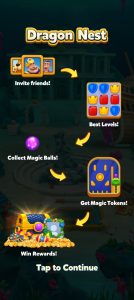
What can be most interesting as a designer is finding ways to bring about togetherness in places that players might not expect. Royal Match recently experimented with this as part of an event. Players had to work together to contribute points to hatch and grow dragons. Only by having a full and active team could players hope to get all of the available rewards.
- Final Fantasy 14’s “the restoration of Ishgard” was an event that called upon all players to band together and contribute towards the restoration of a city, with progress being reflected in-game.
- FarmRPG is an idle farming game, but one that allows players to trade between each other, and also features community goals that every player can contribute to.
- Helldivers 2 makes excellent use of togetherness as part of the general war effort, directing players to play on certain planets in order to complete community-wide goals.
In order for togetherness to emerge, it requires that the right people be placed together, especially for more active or real-time gameplay. A competitive player, a casual player, and a farming player may all want to play the same content in Destiny 2, but they seek to experience that content in vastly different ways that are not aligned. Togetherness will be difficult to achieve between them.
Matchmaking systems and algorythms play an important role in making sure that the right people are put together. Fortnite’s social tags system is a creative way of achieving this by letting players tailor how they get discovered by other players.
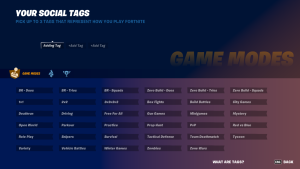
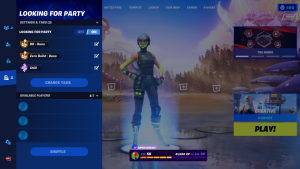
Relatedness is our final building block and the most difficult to bring about. We want players to self-correct their actions based on awareness of what is happening and how other players feel, or to preemptively curb certain behaviours based on that awareness.
Whether this is achieveable at scale in a game or not will heavily depend on whether a virtuous or vicious cycle exists (a whole topic we will cover just a little further down), and might not even be possible at all given the game and its mechanics.
That’s because relatedness requires vectors for player communication and self expression. Taking the Royal Match example from earlier, there will be very little relatedness between the participants of the social event, unless they happen to be friends or guild members whom the player can talk to. For players who are teamed up with random players, there is no one to relate to because the other players might as well be AI bots.
In contrast, in a game like Sky or in an environment like VRChat, paying attention is highly rewarding. One can observe the other players and get a sense of how they feel based on their actions. And actions can have an immediate and perceptible effect, so the feedback loop is extremely fast.
Social Agency
Social agency represent how much a player is able to project their personality, behaviour and quirks into the game; essentially being able to create an accurate (or desired) persona of themselves that other players can recognise. We can explore social agency through both active and passive means.
Active means are all the systems that a player must make a conscious effort to use. Text chat, voice chat, pings, emotes, quick messages, guilds and friend systems are all examples that mainly enrich the social experience when they are actively used.
Passive means, on the other hand, are systems that don’t require an effort to broadcast a ‘message’. Avatar customization, fashion, banners, icons, trophies, titles, achievements, are all passive examples that ‘say’ something about the player just be virtue of existing.
How much social agency exists within a game depends not on the quantity of such features, but mainly how much depth each of them gives to players. A free input text chat and a quick message system both provide a way to transfer information between players, but the free input allows for quirks and personal character to also be conveyed. An online chat room has much more social depth and nuance than a game like Diablo 4 (that has a wide array of social systems, inspired by Massively Multiplayer Online games) that feels deserted and devoid of other humans.
Sky: Children of the Light is a perfect example of engaging social gameplay through depth of systems rather than quantity. Players are very frequently mingling with each other, but by default they are incredibly limited in how they can communicate. It is intially through silent gesturing and acting that they convey ideas and feelings with each other, and from there they can begin to unlock more social systems between each other.
That said, depth for the sake of depth is the wrong design approach. The deeper and more comprehensive a social system is, the more dangerous and vulnerable to abuse it can be. This is something to be extremely mindful of when exploring social opportunities.
Social Opportunity
Putting aside systems for a moment, we also need to understand the impact of where and when players socialize, in other words what type of opportunities we give them to socialize.
Let’s take two examples: Overwatch and Fortnite.
Overwatch is mainly laser-focused on players jumping into matches and having a go at each other. This requires mental concentration and fine motor skills dedicated to the task of supporting your team and bringing down your opponents. Your social interactions with other players will mirror this.
- The communication wheel gives you rapid access to pings, emotes and pre-written messages; it minimizes your need to let go of inputs or the controller to communicate your point, but little else.
- Voice chat, by virtue of decoupling physical input from communication, offers your best chance at actually socializing.
But within the context of an Overwatch match you are under significant pressure from your opponents, from your own team, and from the gameplay parameters that define victory and loss. The more concentrated you are, the better your odds of victory. Socializing – in the genuine sense – requires multitasking, which is dangerous and costly. We can say that the players are experiencing significant cognitive load during matches, and matches are what Overwatch is about.
In contrast, Fortnite is now defined by it’s Creative Mode and wealth of activities that range from Battle Royale to chilling out cozily with friends or watching a musical performance with a huge crowd. This is further reinforced by Epic hosting non-combat events within Fortnite. Players don’t always visit Fortnite for the purpose of gunning each other down. And when they are not aiming weapons at each other, they have far greater latitude for being spontaneous, getting distracted by what’s happening around them, and slowing down to socialize. Depending on the game mode, Fortnite players experience vastly different cognitive loads and come to the game for both high and low load activities.
How much players can – and are willing – to socialize will be highly influenced by their purpose in the game, and the cognitive load of engaging with that purpose.
Their purpose will also significantly color their behaviour. In a low stakes environment, making a mistake is not particularly detrimental, and might in fact be positive because of the social opportunities it created.
In a high stakes environment – especially one that requires a larger time commitment – every mistake has an invisible price on the mood of the participants. Stress, frustration, anxiety, fear and anger will all begin to bubble up, and eventually these feelings will seek an outlet. When that outlet is a communication system, things can go awry very quickly and start a chain reaction of abuse.
League of Legends has always been a very interesting case to study due to its combination of hyper-competitive and team-based gameplay. From disabling the ability to talk to opposing players, making voice chat a friends-only affair, making post-game chat an opt-in affair, and so on, Riot Games has constantly iterated on their social systems to create better environments for players.
When planning systems, it’s not just a question of what players are given, but where they can be used and under which conditions. This is an area where Social Profiles are an excellent tool to help us explore different perspectives with different needs, wants and friction points.
Safety through Moderation, Education and Codes
As mentioned in the Empathy Hierarchy, it’s critical to help players develop a sense of belonging in order for them to socially grow. This is where the concept of safety needs to be up to the task of not only protecting players, but to gain and maintain their trust in those protective systems:
- We need a code of conduct to lay out the red lines and the appropriate punishments
- We need to educate players on the code preemptively before breaches happen and responsively after
- We need the tools and pipeline to allow discovery of code breaches and to enable timely action
Let’s start with the code of conduct, as everything regarding safety stems from, and is scoped, by it:
- As a player, what is acceptable and what isn’t? What are the grey areas of uncertainty?
- As a developer, what is punishable and how strongly should I punish?
Our code will then determine the tools and processes needed to moderate and educate:
- If ban slurs and hate speech, how do I try to proactively filter them?
- If I have an in-game voice chat, how can I ensure that it is as safe as the text chats?
- If I have a user-generated game, how do I prevent players from creating hate symbols?
- If I have tens of thousand of players, how do I ensure that when players report a problem I take action swiftly?
- If a player finds a way to circumvent my safety systems, how can I still take action?
The reality is that the more social a game is, the more expensive it becomes to maintain safety within. Sadly, many developers will want to have their cake and eat it out by trying to reap the benefits of social features without a care for how those same features might hurt their players.
Safety is a massive topic that really requires its own article to explore, but I think there are four points worth mentioning here.
First, be consistent and transparent with your code.
- Define both good and bad behaviours. Don’t simply tell players how they can be villains, but also how to be champions.
- Don’t invent rules out of thin air and don’t arbitrarily punish players beyond the rules you’ve set.
Second, educate your players throughout their game journey.
- Don’t settle for teaching the code of conduct once. Reinforce it, repeat it, keep it accessible.
- When punishing players, be clear about what they did and how it breached the code.
Third, offer players a path to redemption.
- Your ultimate goal is not to rid yourself of troublemakers, but to reintegrate them into the community.
- Explain to players how to better themselves, and withhold permanent bans only for the most irredeamable of offenses.
- Consider modularity in your punishments, such as taking away access to systems, rather than a binary you are banned/you are not banned approach.
Fourth, remember that speed is crucial and communicate with all involved parties.
- Punishment handed out when a misdeed is recent is far more effective than punishment days later.
- Ackowledge the victims and reach out to them, especially after you have taken action.
- Letting players languish in uncertainty is how you destroy trust in your safety systems.
Here are some resources that can help you:
- The League of Legends code of conduct is a great example of clarity and specificity for a socially difficult environment.
- The Brawl Stars code of conduct is another great example of a simpler code designed for environment that is much more contained.
- The Fair Play Alliance website and community are your greatest ally in making the most of your player safety ambitions.
Virtuous and Vicious Cycles
The final step to examining our design work flow is to pull away and look at the full scope of what we are building, and assess whether we are reinforcing a virtuous or vicious cycle.
A virtuous cycle represents an environment where players take it upon themselves to maintain good behaviours and civility between each other, without the need for a developer to tweak or introduce new systems.
A vicious cycle, unsurprisingly, is the opposite: an environment that encourages progressively more hostile actions from players towards other players.
With this in mind it’s easy to understand how our previous five core pillars contribute to building a virtuous cycle, and how gaps can allow a vicious one to emerge:
- Ensuring that players of all profiles are considered and respected by the developer and the community.
- Helping players progressively develop empathy towards their peers.
- Letting players embody and/or project strong personas within the game world.
- Creating opportunities to socialize that don’t turn into pressure cookers of negative emotions.
- Providing safety to all players, giving offenders a chance to redeem themselves, and keeping the community’s trust in us.
Throughout the development of features and content we should be asking if we are fostering a virtuous cycle; whether we are leaving an opportunity off the table; and how our work could be perverted into a vicious cycle. Always be on the lookout for edge cases and ask yourself if someone could get hurt.
Ultimately, good intentions from a developer mean far less than the reality of how players operate with each other. And as a developer you will be judged as much for what you decided to do as to what you decided not to do.
Conclusion
This article has been more than a year and a half in the making, with multiple iterations focusing on different goals, until I finally settled on the current one: a simplified framework for what I consider to be the essential components of creating game worlds that are engaging because to their social systems. In the future I’ll return to each of the topics brought up here and dive deeper into them, as plenty has been left unsaid,
My hope is that I’ve provided you with enough to get you started on your own journey of developing social systems, and also convinced you of their value. Don’t be the person who endlessly puts social systems as the lowest backlog priority!
To summarize the framework:
- Consider your three types of players: Organisers, Members and Observers, and help them grow more confident.
- Think about how your players can learn to see each other as human beings behind avatars and develop empathy through belongingness, togetherness and relatedness.
- Find ways to enable social agency so that players might develop personas project and express themselves into the game world.
- Consider the moments where social opportunities arise and what factors influence players during those moments.
- Grant your players safety, and a sense of agency over what happens to them, so that they might develop resilience and seek to better themselves.
- Examine your work through the lens of a virtuous and vicious cycle, by asking yourself what would happen if you stepped back and let the game unfold without your input.
And of course, find team members who are energized by the idea of being champions of social design. Empower them to act and influence their peers.
As a reminder:
- The Fair Play Alliance is there to support you. It’s not only papers, we also have a Discord channel.
- The GDC Vault is also a treasure trove of research and learnings. The Fair Play Summit track is a great way to begin exploring the Vault.
You can reach out to me via LinkedIn, and I’d be extremely happy to continue discussing this topic with designers and non-designers alike!